
Issue #26: Block Space Health - Structurally Weak, Acutely Pressured
BMHI dimension deep-dive. Composition is slow-bleeding, large OP_RETURN payloads are pinning Security to the floor


There’s a 20-point gap in Bitcoin’s block space scores this week, and the entire post-v30 story sits inside it.
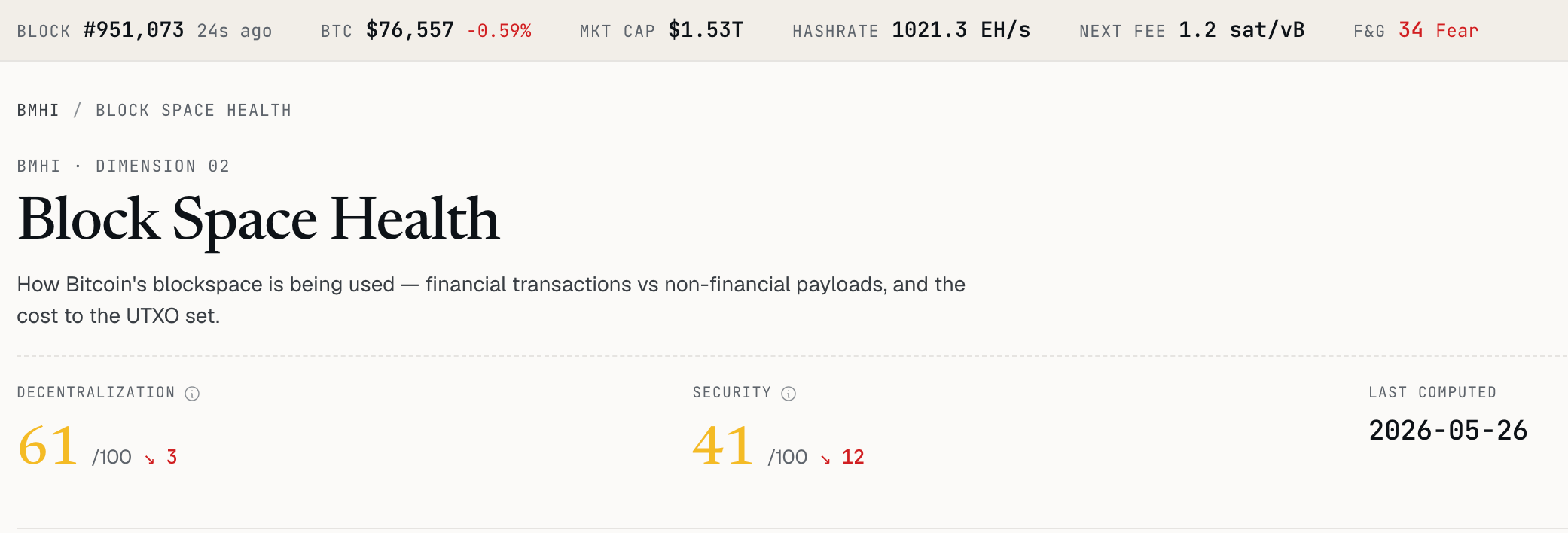
The Bitcoin Monetary Health Index reads Block Space Health two ways: a Decentralization score of 61 and a Security score of 41.
This is the second BMHI dimension to get a full walkthrough, after the Mining pair in issues #21 and #22.
Where Mining decomposes into ownership concentration and supply-chain leverage, Block Space Health asks a narrower question: is Bitcoin’s block space settling monetary value, or absorbing non-financial payloads?
The dimension carries serious weight inside both BMHI super-dimensions: 50% of Security and 40% of Decentralization, because heavy non-financial use degrades both.
On the security side, it raises fee pressure on monetary users (an incentive problem) and increases the probability that harmful or outright illegal payloads end up permanently embedded in the chain — the large OP_RETURN penalty, inherited by every full node operator by default.
On the decentralization side, it bloats the UTXO set and chain footprint in ways that push against the cost of running a node, eroding the very property that lets users verify monetary rules without trusting anyone.
But those two problems operate on different timescales. Composition shifts slowly. Large OP_RETURN inclusions are episodic. Collapsing them into one score erases information. So the model splits the output.
Today’s reading
Composition: 46% non-financial vbytes (90-day average) → 54
UTXO set: 165.4M, flat trend → 73
Large OP_RETURN payloads (30d, >1KB): 29 transactions → −20 penalty (maxed)
Base = 0.625 × 54 + 0.375 × 73 = 61 Decentralization = 61 Security = max(0, 61 − 20) = 41
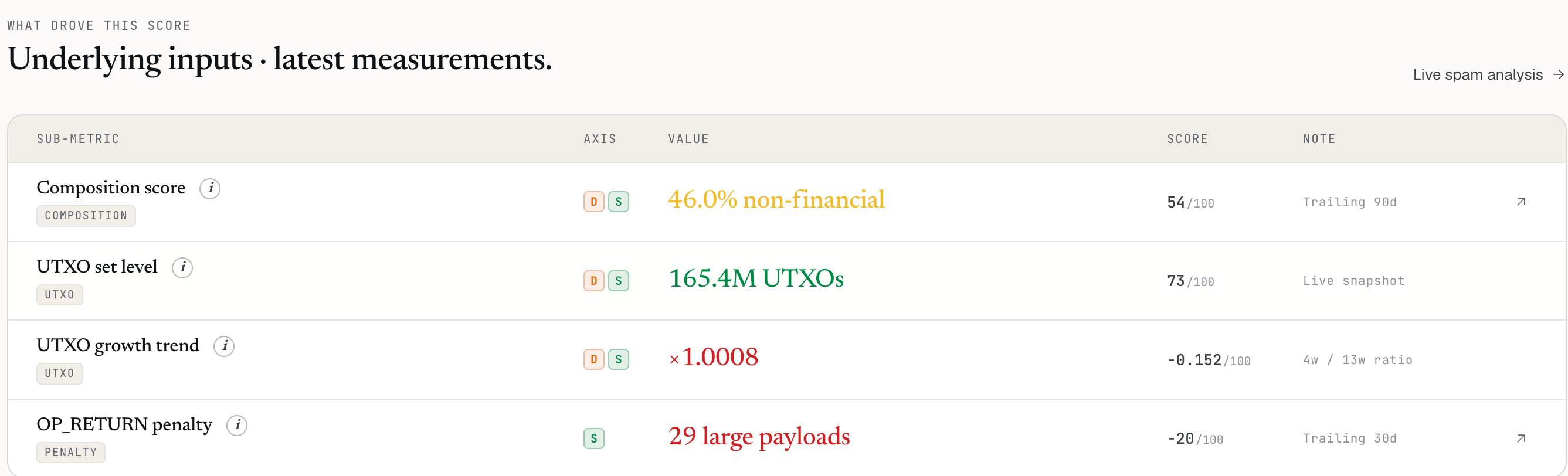
The headline: the structural state is weak, the acute pressure is severe, and the two are tracking different things.
The rest of this issue walks through the model: The three inputs, how they compose, what changed in the v2.1 recalibration, where my own design choices sit, and what the 13-week trajectory implies for the months ahead.
