
Issue #29: Counting the Leaves
Core’s newest argument against BIP-110 says it catches only a few percent of spam. The number is correct. The conclusion is wrong, twice.

There’s a new version of the case against BIP-110 going around right now.
It runs like this: “BIP-110 restores the 83-byte limit on OP_RETURN and kills the inscription envelope. Fine. But look at what’s actually filling Bitcoin’s blocks today. The spam has moved. It isn’t fat inscriptions anymore, it’s a flood of tiny, sub-83-byte OP_RETURN outputs, millions of them, and BIP-110 doesn’t touch a single one. So the soft fork would catch a few percent of the live problem at most. It’s irrelevant.”

I’ve spent the past stretch in my own block data on exactly this, and I’ll tell you up front: By transaction count, BIP-110 would catch a small portion of what is flowing right now.
But Core’s conclusion is still wrong. For two separate reasons. Let me show you what’s down there first, then take the two reasons in turn.
What’s actually in the small OP_RETURN
When I went to decode those tiny OP_RETURN outputs, I expected Runes. That was the obvious answer. Runes, Casey Rodarmor’s fungible-token protocol, the majority of Bitcoin’s transactions through 2024, has collapsed.
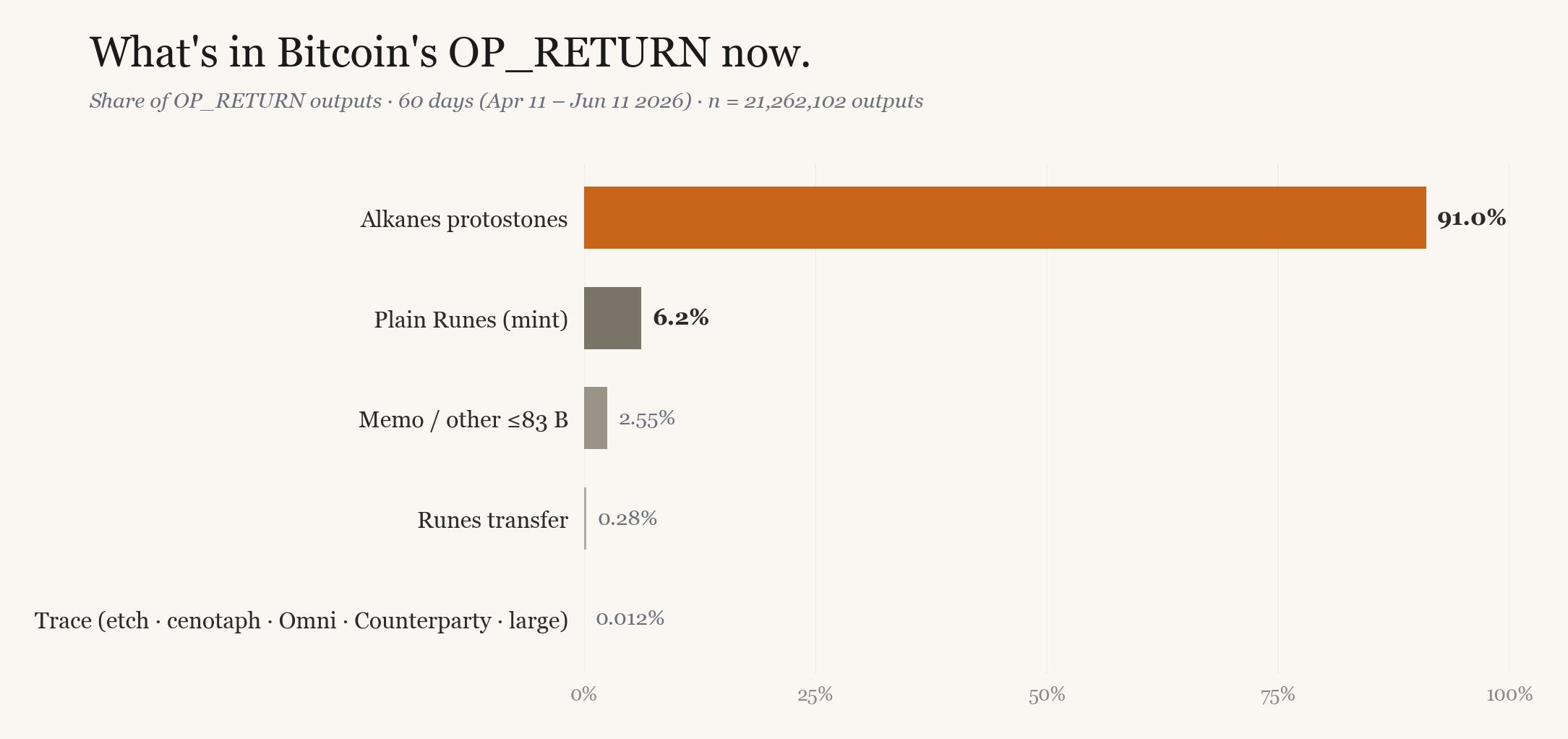
It’s down to under 2% of network activity. Whatever is filling the OP_RETURN surface today, it isn’t Runes.
I decoded every OP_RETURN output on the chain by protocol marker, Over a 60-day window, and 91% of them are Alkanes protostones. The calldata of a Bitcoin-native smart-contract metaprotocol that rides inside a Runes-compatible envelope.
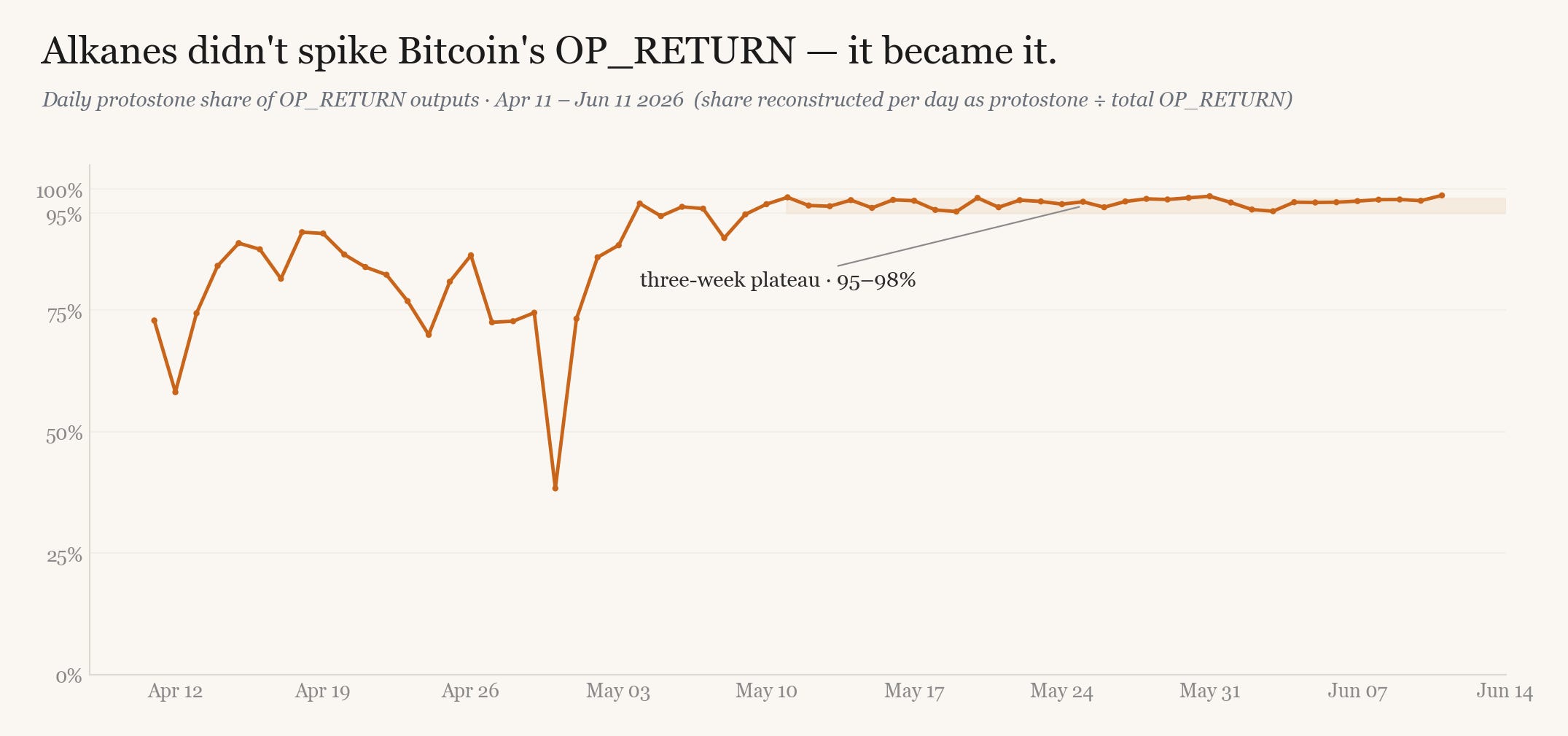
The protostone share climbed through May and has sat at 95–98% every single day for three straight weeks. This is a steady state, not a mania. One funded protocol now is the OP_RETURN surface of Bitcoin.
Alkanes on OP_RETURN
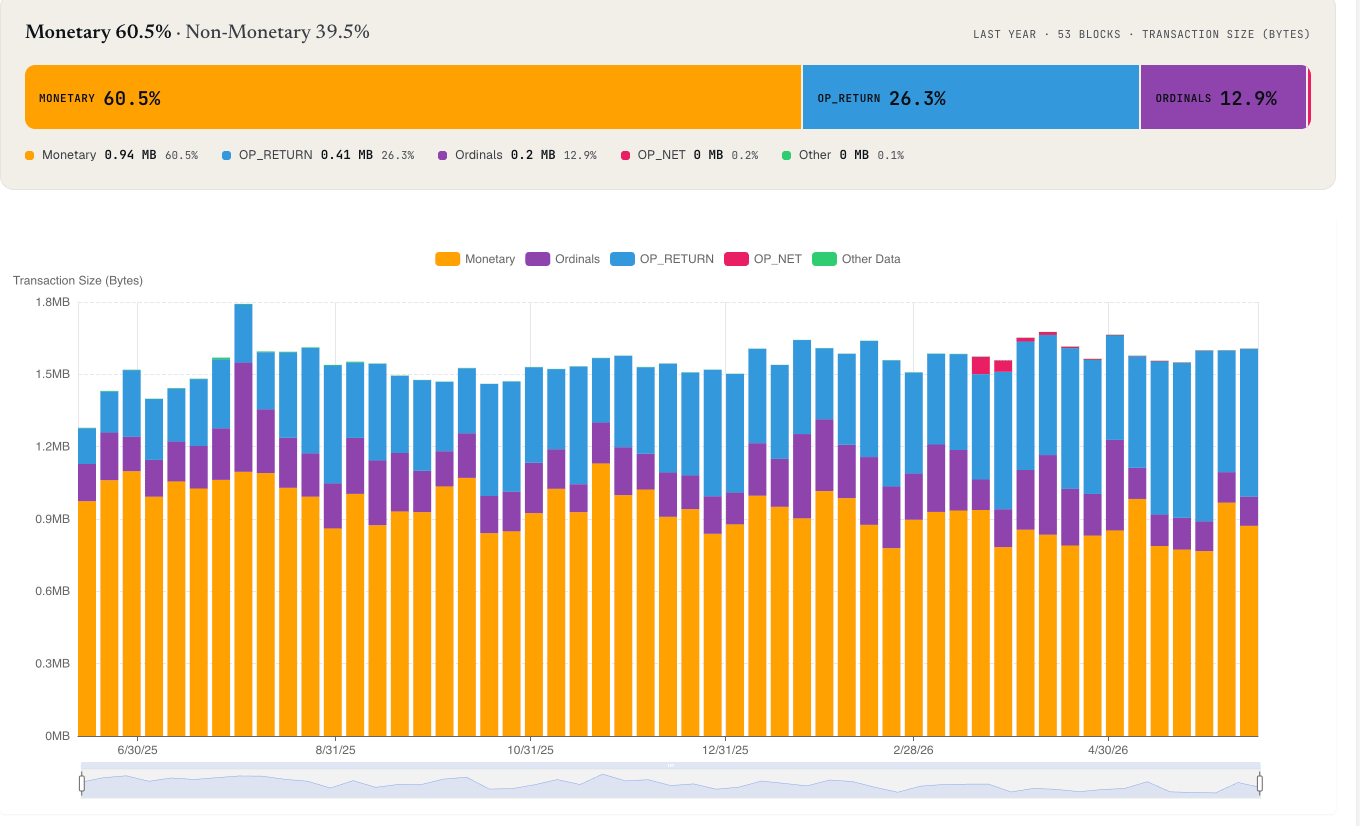
A note on what "91%" measures: The OP_RETURN category itself has more than doubled share of block space over the last 12 months, from around 13% to around 34%.
Monetary vs. non-monetary volume - last 90d
And here’s a question I’m going to leave open: Is some of this migration a response to BIP-110? Are the people building these schemes already routing around a door they can see is closing? I don’t know, and I won’t pretend the chain tells me motive. But hold the thought. It matters more by the end than it looks now.
What 91% actually costs
A protostone transaction imposes three different loads:
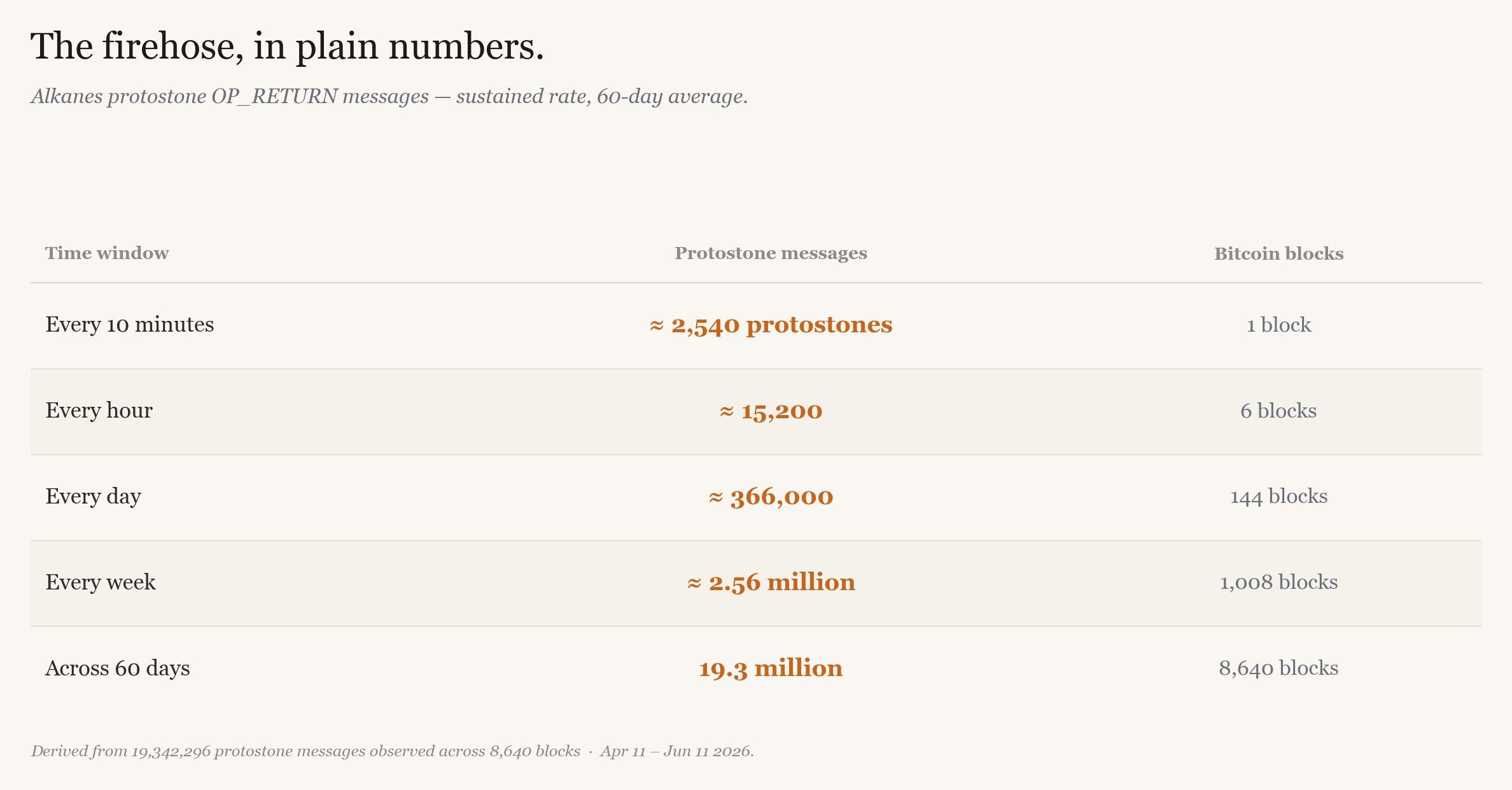
It writes to the blockchain, permanently. About 5.2 GB of block space over the two-month window (39% of everything Bitcoin produce) stored forever by every full node, of which roughly 450 MB is OP_RETURN payload itself; the rest is the transactions that carry the messages. That’s real, and it’s the cost that doesn’t go away.
It generates enormous transaction throughput. Around 2,540 protostones per block. A constant firehose of transactions competing for space. This is the loud cost, the one you see in the block.
It barely touches the UTXO set. And this is the surprising one. I went looking for the dust and it isn’t accumulating. I sampled the carriers directly against my node: the dominant shape, about 99% of them, is a plain P2WPKH self-spend, and in the sample every one of those had already been spent. The carriers churn. They’re created and respent, not parked. So the protostone surge produces a big flow but almost no lasting stock.
In contrast, when inscriptions hit in 2023, they left a durable scar on the UTXO set that you can see in the public composition charts. The P2TR line ramping and staying elevated. That was persistent footprint.
Alkanes is the opposite kind of load: It taxes block space and the permanent record, but it does not bloat the set, because it doesn’t leave its outputs lying around. If you measure this protocol by UTXO growth, you’ll conclude it’s harmless and you’ll have measured the wrong thing.
Which is the theme. Let’s get to BIP-110.
The wrong meter, part I: you don’t delete a metaprotocol by deleting its mints
Here is the move the “few percent” argument makes without saying so: it assumes that to matter, a filter has to remove the volume. Count the millions of protostone mints, observe that BIP-110 catches none of them, conclude irrelevance.
But that’s not how you stop a metaprotocol, and the data shows why.
Those 19 million messages are mints, transfers, and contract calls. They’re interactions with contracts that already exist.
Alkanes uses a factory model: You deploy a contract’s code once, and from then on everyone interacts with it by sending cheap, tiny protostone messages. The volume is all interaction. None of it is deployment.
Deployment is a different animal entirely. To put a new contract’s code on chain, you have to embed a compressed WebAssembly binary in a Taproot reveal (a real, kilobyte-scale blob). That is precisely what BIP-110 rejects: its rule limiting witness data pushes to 256 bytes invalidates any such embed outright.
Over the same 60 days, the chain saw 627 transactions carrying the structural signature of a code deployment — a compressed binary in a Taproot reveal larger than 256 bytes.
Every single one of the 627 exceeds the limit. Not one would survive BIP-110. The smallest was 260 bytes; most ran from one kilobyte to sixty-plus.
A confirmed-Alkanes subset of 57 carry a protostone in the same transaction; the rest are a mix of inscriptions and other protocols using the identical embed-a-binary technique.
The deployments are one-shot. Of the distinct binaries, 93% appear exactly once deployed, then never re-uploaded.
The deployable code surface is 0.003% of all Alkanes-shaped activity. However, deployments are the roots the spam grows from. Every one of those 19 million mints exists only because a contract was deployed for it to mint against.
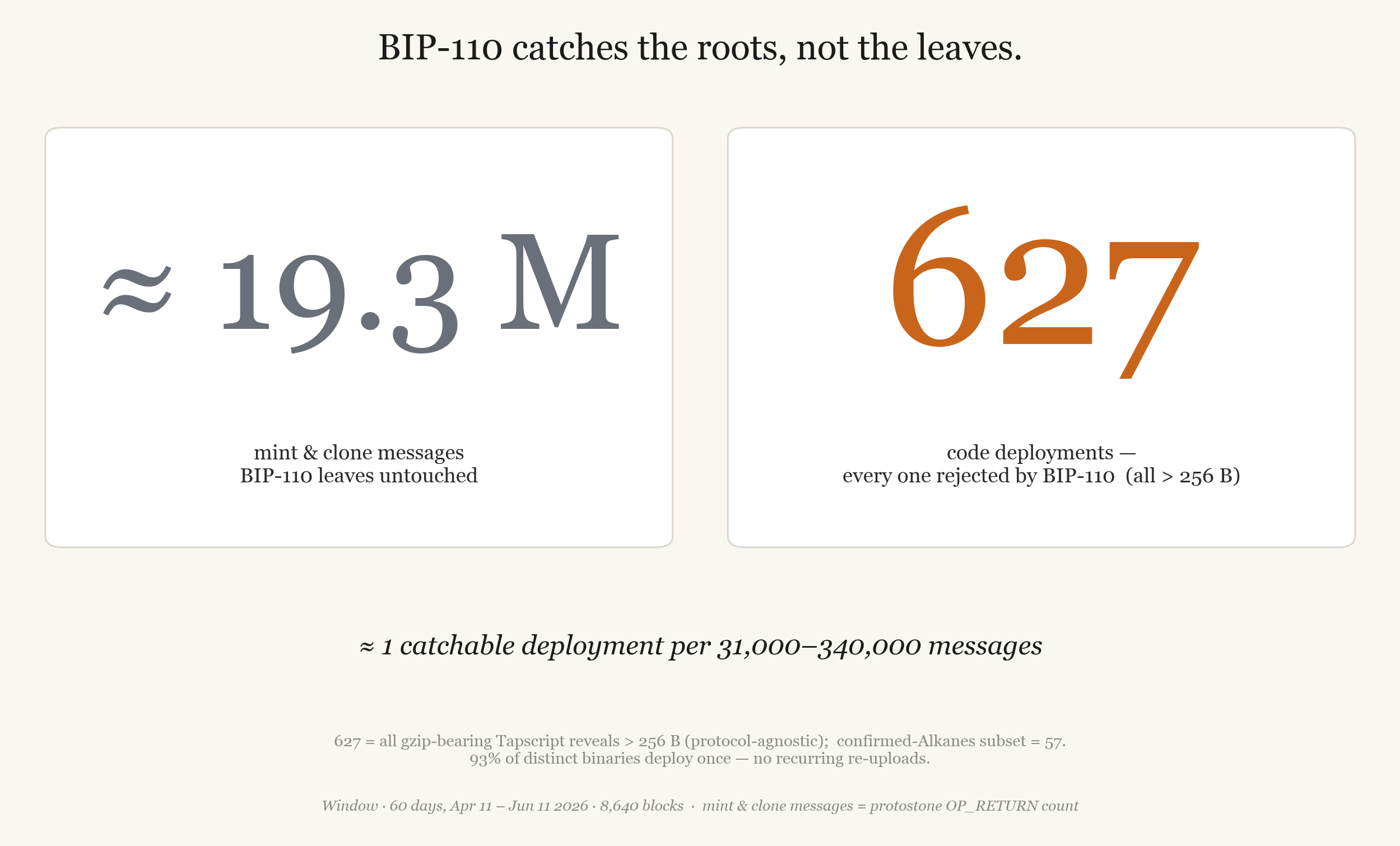
BIP-110 doesn’t delete the 19 million leaves. Instead, it makes the roots prohibitively expensive to plant. It closes the standard path by which new contract code reaches Bitcoin’s base layer at all. That’s why “it catches only a few percent” is the wrong meter. You’re counting leaves.
A protocol that can’t get new code on chain is a protocol whose frontier stops advancing. The next Alkanes doesn’t get built on Bitcoin L1.
But, “couldn't a deployer just split the binary across many small pushes and reassemble off-chain?” Yes, and the BIP says so itself. But that misreads what the rule is for. It was never meant to make embedding impossible; it makes it non-standard, fragmented, and costly. The moment you're smuggling your data in disguised chunks, you've conceded it clearly is bot a use Bitcoin supports. For a protocol whose entire pitch is frictionless deployment, turning the clean path into a deliberate hack is not a detail. It's the cost going back up.
The wrong meter, part II: rare is not the same as harmless
“Only a few percent” is also dismissing the categories BIP-110 is most directly built for: Inscriptions and large OP_RETURN.
I’ve written about these before, so I’ll be brief, but they cannot be left out.
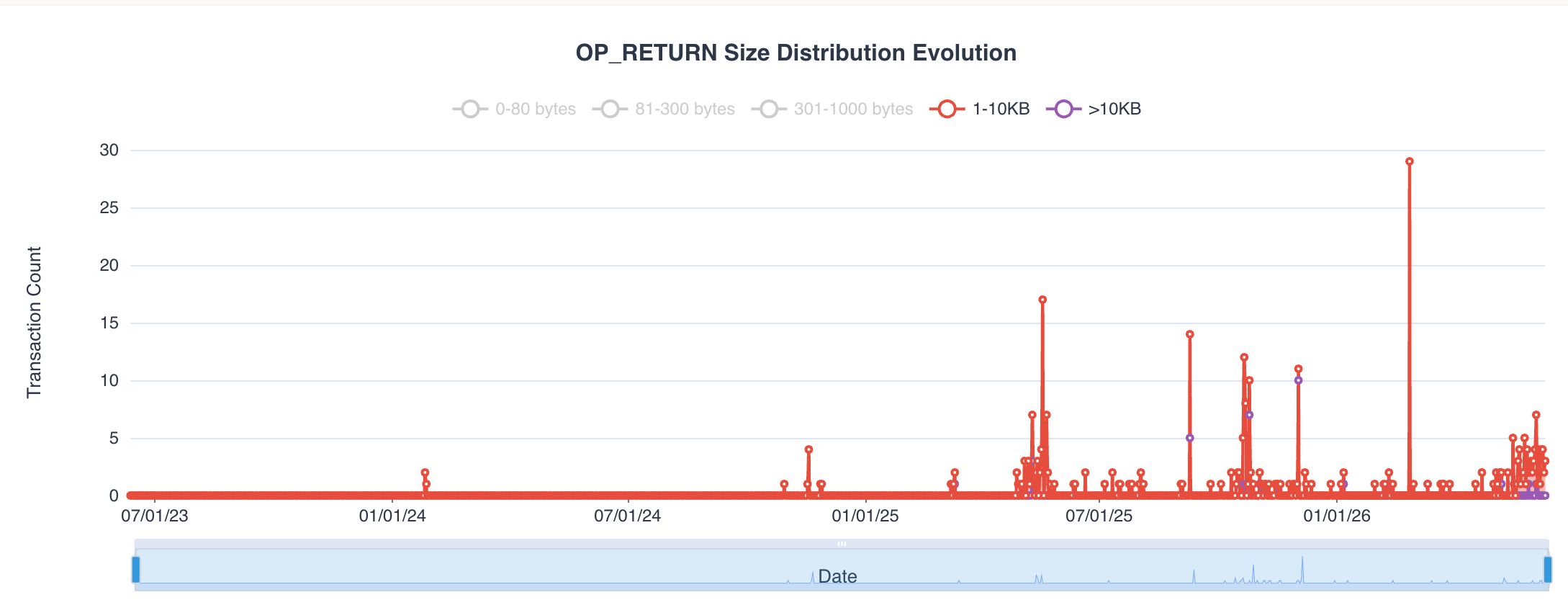
Yes, large OP_RETURN is rare by volume. But look at the trajectory rather than the level. Through 2023 and 2024, large OP_RETURN sat flat on the floor. In 2025 the spikes start; through early 2026 they recur, more often, where before there was nothing. The line that’s lifting is exactly the line rule #1 cuts.
Large OP_RETURN (>1KB) frequency
And volume is not the right axis for this category because the harm isn’t volumetric. A single large OP_RETURN can carry liability-bearing content that every node operator then stores and serves forever, with no way to remove it. You don’t price fire insurance on how often houses burn. You price it on what a fire costs and the fact that you can’t undo one. The cost of permitting this category is asymmetric and irreversible; the cost of rejecting it is bounded and small. That it is rare today is not an argument for leaving the door open, it’s the argument for closing it cheaply, now, during the quiet, before it isn’t quiet.
Inscriptions are the same shape of argument. Quiet now, relative to 2024 but the vector is wide open, and as we saw above, the inscription-style envelope is precisely the embed that BIP-110’s rules invalidate.
A defense that only works against the fad currently walking through the door is worthless. You defend the vector, not the fad. Inscriptions being calm at the moment is not evidence the door should stay open; it’s the cheap moment to install the lock.
The 19 million protostone mints, sub-83-byte, payment-shaped, is genuinely best handled in policy, not consensus. Knots filters it by default already. BIP-110 leaves it alone, by design, and that’s correct.
The load that looks like money
One of the growing activity on the chain right now doesn’t show up where you’d look for it.
It’s 91% of one surface and invisible on another. It’s settled by transactions shaped exactly like ordinary payments, which is why no content-blind rule can catch the volume and why it shouldn’t try. The loud part is harmless-ish; the dangerous part is rare and quiet; and the thing that ties the room together is a funded, coherent push to make Bitcoin a platform rather than money.
Because that’s what this is, underneath. Alkanes isn’t anonymous spam. It’s a venture-backed metaprotocol with real names and real capital behind the tooling, building memecoin and DeFi rails on the Bitcoin base layer.
BIP-110 does closes the door the next scheme’s code comes through, restores the discipline on the category that can do irreversible harm, and draws the line in consensus where a hostile miner can’t step over it.
— Renaud
If you found this analysis useful, consider subscribing. It helps this work continue.
Disclaimer: This newsletter provides data analysis and commentary on Bitcoin network activity. It is not financial nor legal advice. I have no financial stake in Bitcoin Core vs Knots, mining pools, or any related projects. Data accuracy: blockchain analytics involves classification decisions that may differ from other methodologies. I welcome corrections from any party who believes data presented here is inaccurate.