
Issue #6: BIP-110 — The Countdown Has Started
How activation works, what's at stake, and what to watch for

Summary
BIP-110 is not a proposal waiting for approval. It’s a timeline.
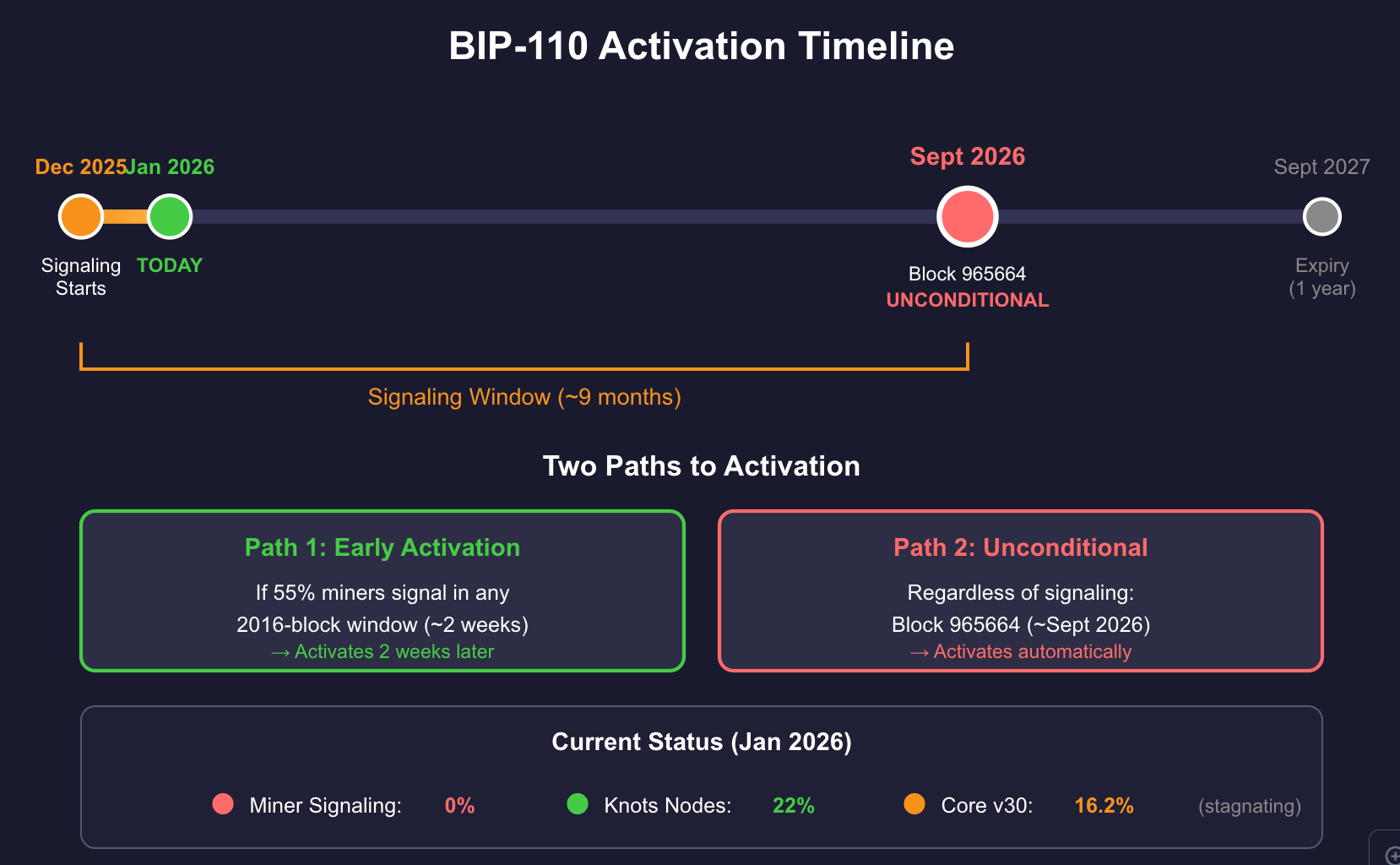
Miner signaling at 55% triggers activation, but regardless of signaling, BIP-110 activates at block 965,664 (~September 2026). This is by design.
After three years of spam on Bitcoin (see Issue#3) and no meaningful action, BIP-110’s author built a mechanism that doesn’t require permission. Miners can cooperate early or accept activation later.
Miners opposing BIP-110 will face a fundamental contradiction: Keep mining Bitcoin while rejecting its monetary focus and purpose. That position may prove economically and philosophically untenable.
This issue explains the mechanism, the reasoning behind it, and the signals to watch for.
The countdown has started.
The Activation Mechanism
BIP-110 uses a modified BIP-9 deployment with one critical addition: an unconditional maximum activation height.
Timeline:
December 1, 2025: Signaling period begins
Any time before Sept 2026:
If 55% miners signal in a 2016-block window, BIP-110 activates 2 weeks later
~September, 2026: Block 965664: It activates unconditionally
~September 2027: It expires after 52,416 blocks (~1 year)
The key innovation:
Traditional soft forks (SegWit, Taproot) required 90-95% miner signaling. This gave miners effective veto power.
BIP-110 requires only 55% for early activation and activates anyway by September 2026 regardless of signaling.
Miners can accelerate but cannot prevent.
Why This Design
This approach didn’t emerge in a vacuum. Context matters.
Three years of inaction:
2023: Inscriptions emerge. Core response: “Spam can’t be stopped“
2024: Runes created. Core response: “Not worse, helps against UTXO bloat“
2025: Spam takes 37% of used block space. Core response: “v30 expands OP_RETURN default policy limits to 100KB, with plans to deprecate the configuration parameter in future releases.“
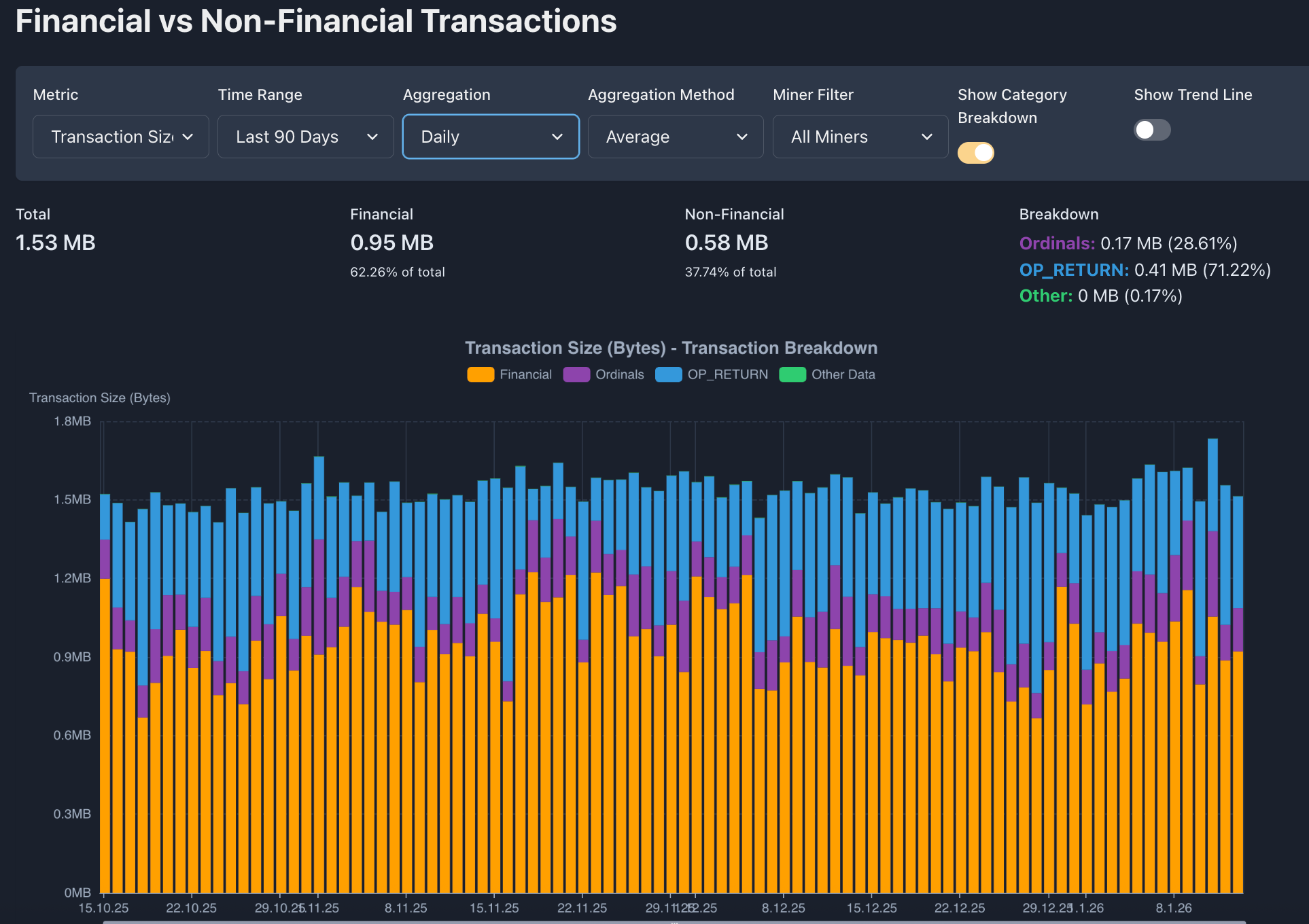
Financial and non-financial transactions size on blockchain
Bitcoin Core developers chose neutrality, or worse, accommodation. The community asked for action but none came.
Knots alone is insufficient:
While Bitcoin Knots adoption rise is a key signal, only a fraction of the hashrate runs Knots. In addition, most large inscriptions (>1MB) are “not seen in Mempool” i.e. submitted directly to miners, bypassing relay policy entirely.
Relay filtering without consensus enforcement is a leaky bucket.
The existential concern:
Unmoderated large file storage on Bitcoin poses risks beyond annoyance:
Regulatory exposure if illegal content is inscribed on-chain
Mission drift: Bitcoin as file storage competes with Bitcoin as money
BIP-110’s author concluded:
Asking permission hasn’t worked. The mechanism used here reflects reality.
If this analysis is useful, consider subscribing. It helps this work continue.
What This Means for Miners
Miners face a decision with no neutral option.
Signaling = supporting filtering spam
A miner who signals BIP-110 publicly aligns with the position that Bitcoin should prioritize monetary use over data storage.
Not signaling = accepting the status quo
A miner who doesn’t signal, especially as September 2026 approaches implicitly endorses the current spam-permissive environment.
Post-activation resistance = active opposition
After activation, miners who include non-compliant transactions produce invalid blocks (from BIP-110 nodes’ perspective). This is technically possible but economically risky. Orphaned blocks mean lost revenue.
The reputational dimension
When any content can be permanently inscribed on-chain by any miner, the question of responsibility becomes unavoidable.
Before BIP-110, miners could claim they had no effective tool to prevent large file storage. BIP-110 removes that excuse.
Opposing it now means publicly accepting that any miner, anywhere, can inscribe any content permanently on Bitcoin, and choosing not to stop it.
For institutional miners with stakeholders, compliance requirements, and reputations, that’s a difficult position to hold publicly.
The question is no longer “can we prevent this?” but “why don’t we?”
I’m not predicting how they’ll act. I’m noting the pressures they face.
Current Status
Miner Signaling:
As of January 17, 2026, 0% signaling. This is entirely expected as the current release (v0.1 RC2) is still in pre-release candidate stage i.e. not recommended for production deployment.
The meaningful signaling window begins after a stable release is available.
Node Adoption:
While miner signaling hasn’t started, node adoption has started (0.43% at time of writing).

Nodes BIP-110 adoption rate
Node adoption doesn’t trigger activation, but it signals community sentiment. And sentiment becomes pressure.
What to Watch For
It’s risky to assign probabilities to scenarios. There are too many unknowns and too many actors with opaque incentives.
But here’s what would indicate each path:
Signs of smooth adoption:
A major pool (Foundry, AntPool, ViaBTC) starts signaling early
No coordinated public opposition from mining industry
Node adoption continues growing
Inscription services begin migrating to alternatives (sidechains, other protocols)
Signs of contention ahead:
Mining pools publicly oppose BIP-110
Industry lobbying or legal threats against activation
Coordinated “big block” or “no filter” narrative campaigns
Exchanges or infrastructure providers take sides
Signs of quiet acceptance:
No signaling, but no opposition either
Miners wait for unconditional activation
Post-activation compliance without enthusiasm
“Let’s see how the 1-year trial goes” sentiment
The Forces at Play
Predicting outcomes requires understanding incentives.
For BIP-110:
Those concerned about ethical/regulatory/legal exposure
Node operators burdened by chain growth
Users facing fee competition with spam
Developers focused on monetary use cases
Against BIP-110:
Those who view consensus changes as inherently risky.
Those who conflate filtering and censorship.
Those in favor of Bitcoin centralization (big pools can do the filtering)
Inscription services and infrastructure (direct economic interest)
Miners with inscription side-deals
The honest assessment:
Significant economic interests benefit from the status quo. Inscription services, mining pools with direct deals, and infrastructure built on cheap data storage won’t disappear quietly.
BIP-110’s unconditional activation forces a confrontation that previous soft forks avoided. Whether that confrontation is brief or prolonged depends on factors difficult to predict.
Tracking Progress
I’ve added BIP-110 monitoring to The Bitcoin Portal: https://thebitcoinportal.com/nodes/bip110
Miner Signaling:
Real-time tracking of bit 4 in block headers
Progress toward 55% threshold
Breakdown by mining pool
Node Adoption (listening nodes):
BIP-110-compatible nodes on the network
Knots vs Core breakdown
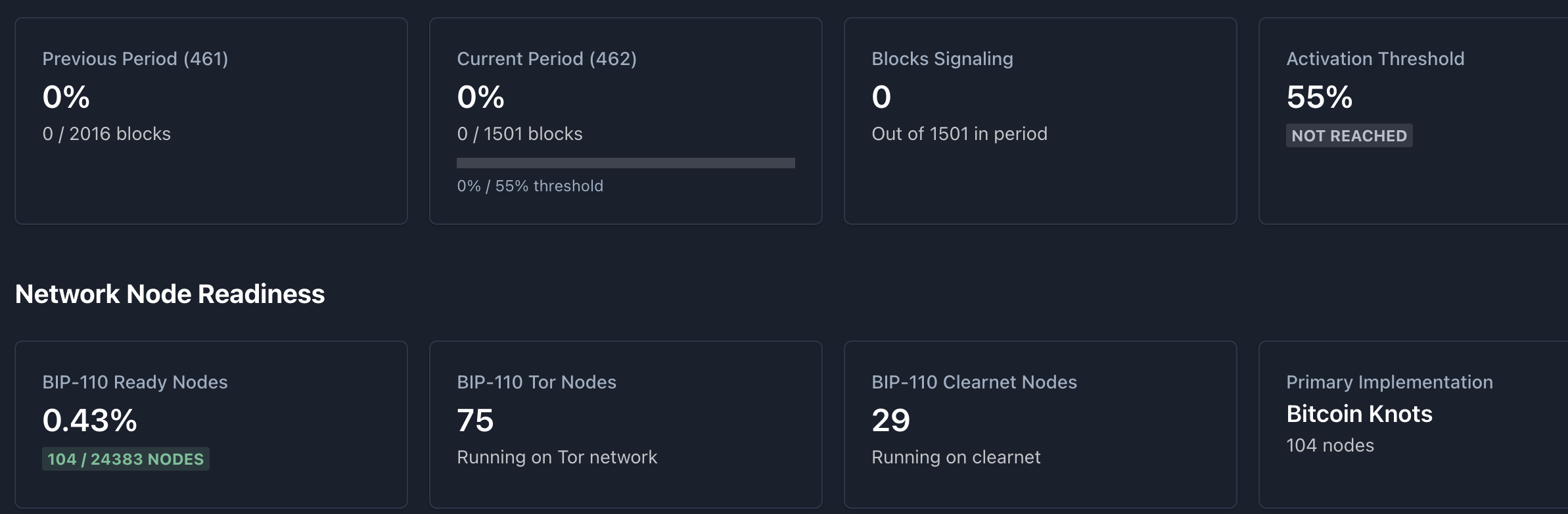
BIP-110 Miners signalling and nodes adoption
Conclusion
BIP-110 is happening. The mechanism ensures it.
The only questions:
When? Early via 55% signaling, or September 2026 unconditionally
How? Cooperatively, passively, or contentiously
Three years of spam produced no action from Core.
BIP-110 is the community’s response: a solution that doesn’t require permission.
The countdown has started. I’ll be tracking it.
Bitcoin data available at:
https://thebitcoinportal.com
Disclaimers
This newsletter provides data analysis and commentary on Bitcoin network activity. It is not financial advice.
What this is:
Analysis of blockchain data
Discussion of network health concerns
Technical examination of protocol changes
My personal opinions based on available data
What this is NOT:
Investment advice
Trading recommendations
Price predictions
Financial guidance
I have no financial stake in Bitcoin Core vs Knots, mining pools, or any related projects.
Do your own research. Make your own decisions.
Legal and regulatory discussions are presented for informational purposes only and do not constitute legal advice. Consult qualified legal counsel for specific situations.
Data Accuracy
While I strive for accuracy, blockchain analytics involves classification decisions that may differ from other methodologies. Aggregate statistics are derived from my own data processing pipeline and have not been independently audited. Individual large OP_RETURN transactions can be verified on public block explorers. I welcome corrections from any party who believes data presented here is inaccurate.
This will just make UTXO bloat even worse, raising the costs of running a node for users. It will also exacerbate the issue of transactions skipping the mempool entirely which will lead to miner centralization. BIP-110 is short-sighting, misinformed, and aggressive in how it approaches "soft" fork activation.