
Issue#28: The Freedom-Text Trap
Three “freedom documents” just landed on Bitcoin in three days. The texts are noble. That’s exactly why you should look closer.

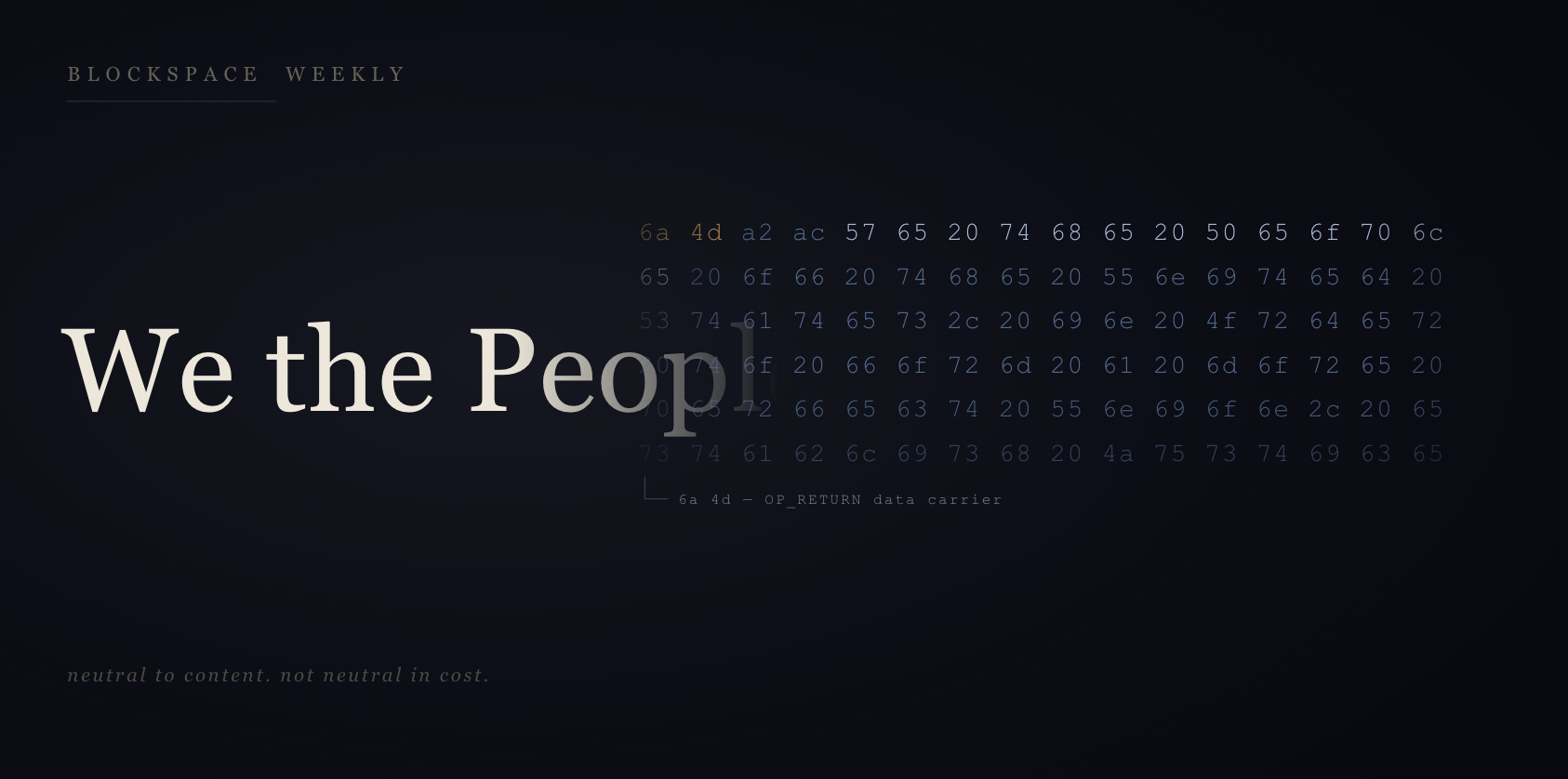
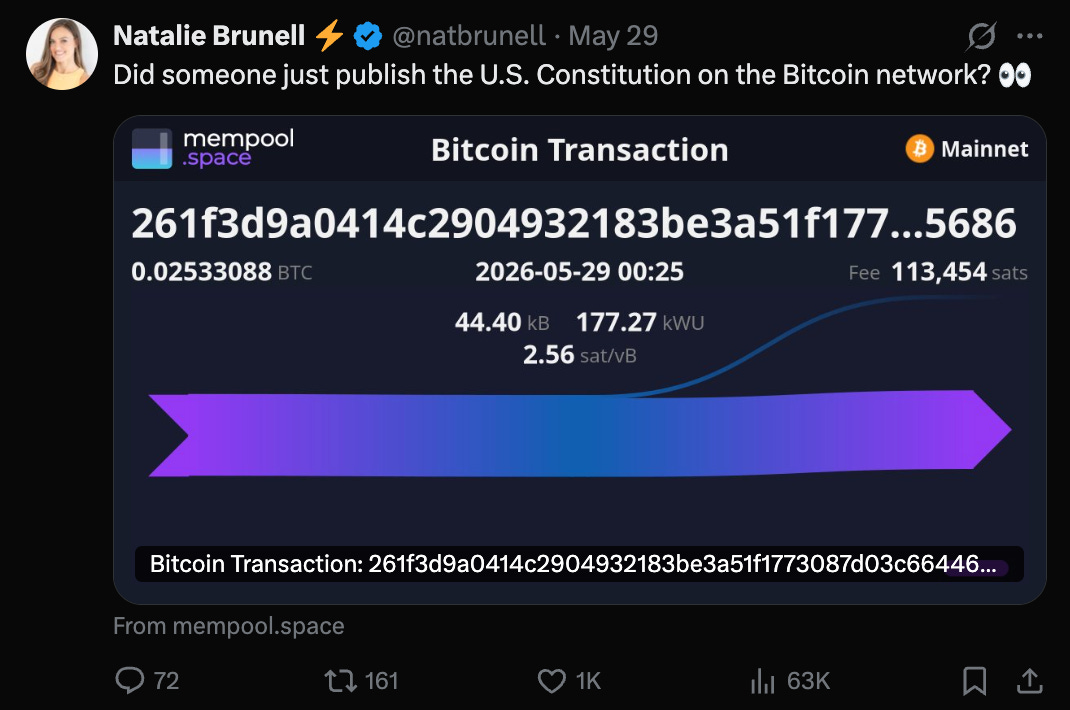
On May 29, the text of the U.S. Constitution was written onto the Bitcoin blockchain via OP_RETURN.
It traveled. The same day Natalie Brunell, a Bitcoin journalist with a large, mainstream-leaning audience, posted to X: "Did someone just publish the U.S. Constitution on the Bitcoin network?" The like count climbed into the thousands.
The framing seemed clear: A freedom milestone. The world's founding charter of liberty, now living on the world's most censorship-resistant ledger. What's not to love?
Then, with almost no noise, two more arrived: The Cypherpunk Manifesto and Aaron Swartz’s Guerilla Open Access Manifesto. Three foundational liberty texts, inscribed within roughly seventy-two hours of one another.
I’ve checked quite a few large OP_RETURN transactions on this chain. There is no shortage of embedded text down there, but it usually reads like what it is: random payloads, test data, and a fair amount of people bragging about stuffing blocks with junk. The register is neutral at best, trollish at worst.
These three are different and they showed up in the same handful of days, in escalating order: A national charter, then a movement’s manifesto, then a martyr’s. That shift in register is the observation.
The question I’m not going to answer
We are in the middle of a real fight over what Bitcoin is. BIP-110, the data-carrier debate, the v30 relay change.
In any contest this consequential, the side that holds the moral high ground has an advantage. So we should expect attempts to capture it.
A cluster of beloved freedom texts, arriving on a beat, framed on social media as a victory for liberty, is precisely the shape such an attempt would take.
Is it one? The instinct is to go looking, so I did. I traced the funding behind all three transactions several hops back, hunting for a shared source. Different wallets, different origins, no common ancestor in the depth I traced. But that settles nothing, in either direction. A shared wallet would prove only carelessness; separate, unlinked wallets are exactly what any competent actor would arrange. The chain records what moved. It does not record why. So I won't allege what I can't prove.
But here’s the thing: the origin is the smaller question.
The trap
The freedom-text framing is powerful as it’s difficult to argue against without risking looking like the villain. Object to the Constitution on Bitcoin and you appear to be the person wanting to censor the Constitution. The form is the argument. That’s what makes it good rhetoric.
It’s also what makes it a trap because it relies on you not applying the defenders’ own principle consistently.
The case for these inscriptions rests on content-neutrality: the network must include any transaction that pays the fee, regardless of what it carries. That’s the principle.
But content-neutrality means the medium cannot tell the Constitution from anything else. By default, it does not read what it stores. Which means the exact same channel, justified by the same principle, carries whatever else someone decides to make permanent, including material that is illegal to possess, hosted forever by every node operator who chose none of it.
So the freedom framing refutes itself. You cannot simultaneously claim the content is noble and content doesn’t matter. Either content matters, in which case the principle is already conceded, and we are merely negotiating which content, or content truly doesn’t matter, in which case the Constitution was never the point.
“But filtering is worse than the disease”
This is the typical counterargument we’ve addressed in previous issues. The claim is that protocol-level content limits are a worse cure than the problem, that any filtering betrays neutrality and starts the network down the road to permissioned.
It rests on a false premise: that a protocol with no constraints is the free one, and any limit is censorship imposed on an otherwise neutral medium.
No protocol works that way. Every protocol is defined by what it optimizes for, and refusing out-of-scope payloads is not censorship, it is the optimization that makes the protocol what it is. A voice codec drops frames that would blow its latency budget; it is not silencing speech. TCP enforces structure to guarantee ordered delivery; that constraint is the thing that makes it useful. Constraints that serve the core function are not gatekeeping. They are identity.
A protocol that refuses to optimize for anything is not maximally free. It is undefined. And an undefined monetary protocol does not survive contact with adversaries, because they will define its scope for it, optimizing it for their use case at the expense of yours. Refusing to defend your scope doesn’t keep you neutral. It just hands the decision to whoever has the most resources. This is the centralization pressure we are already watching.
Bitcoin’s core function is sound money. Permanent storage of arbitrary documents is corrosive to it, in node-operating cost and in legal exposure.
A monetary protocol must optimize for money. Not may. Must, if it intends to survive.
One caution, because the punchline has a hijack. “Content matters, so optimize for money” invites a reply that sounds like agreement: Ok fine, let the responsible pools handle the bad content. That is not the same argument. It is the opposite one. The discipline has to live in the protocol’s economics not in the discretion of whoever happens to mine the block. A network that depends on trusted parties to filter its content has already surrendered the property that made the content worth filtering for.
Bitcoin is not a library
Not because anyone decreed it. Because of what it is for.
The texts are good. The Constitution is a triumph of human governance. The Cypherpunk Manifesto is foundational to everything many of us believe. Swartz was right about open access.
None of that is in dispute, and none of it is the question.
The question is whether the most important monetary network ever built should also be a permanent, unfiltered store of arbitrary content, and the moment you take the defenders' own principle seriously, the answer writes itself.
Noticing the trap is not hostility to freedom. It’s the opposite. The thing that actually secures freedom: A credibly neutral, decentralized, surviving money, is exactly what gets spent if we let it be reframed into a bulletin board because the bulletins were beautiful.
The high ground
The side holding the moral high ground holds an big advantage. That’s the reason these inscriptions matter. They appear as a bid for that ground, an attempt to plant the flag of freedom on one side of the data-carrier debate.
But the high ground was never theirs to take, because the framing inverts what’s actually at stake. The case for limits is not a case against freedom. It is the case for the one thing that has ever made Bitcoin matter: Money that no one can debase, capture, or quietly redefine.
Money that works the same for a dissident as for a billionaire, and keeps working in twenty years because the cost of running it stayed within reach of ordinary people.
The high ground belongs to the side keeping Bitcoin usable as money for everyone.
Signal, not noise. Even when the noise quotes the Constitution.
If you found this analysis is useful, consider subscribing. It helps this work continue.
Disclaimer: This newsletter provides data analysis and commentary on Bitcoin network activity. It is not financial nor legal advice. I have no financial stake in Bitcoin Core vs Knots, mining pools, or any related projects. Data accuracy: blockchain analytics involves classification decisions that may differ from other methodologies. I welcome corrections from any party who believes data presented here is inaccurate.
Hopefully soon somebody will upload the 1986 classic Top Gun, directly to the blockchain. Actual freedom material!
Each frame, base64 encoded, for the world to enjoy! It is the morally correct thing to do.